
How HBL Develops a Youth Athlete
HBL is a structured, education-driven basketball program. Athletes don’t just “play a season” — they follow a consistent development system designed to build confidence, competence, and game-ready habits.
What Parents & Athletes Receive
Every family is enrolling into a development system, not a one-off clinic or a typical rec season.
- Tier placement based on readiness (not age alone)
- Trainer sessions focused on how to perform skills (mechanics + reps)
- Coach sessions focused on when & why to apply skills (decisions + spacing)
- Games built to reinforce learning through rules, constraints, and accountability
- Consistent standards so quality does not depend on “which coach you get”
How to Measure a Successful Season
Success is not “my child scored more points.” Success is growth you can see under pressure.
- Better decisions with and without the ball
- Improved balance and composure (less rushing, fewer panic plays)
- Cleaner spacing and timing (more purposeful movement)
- Stronger defensive habits (positioning, effort, fewer unnecessary fouls)
- More confidence and willingness to try the right play
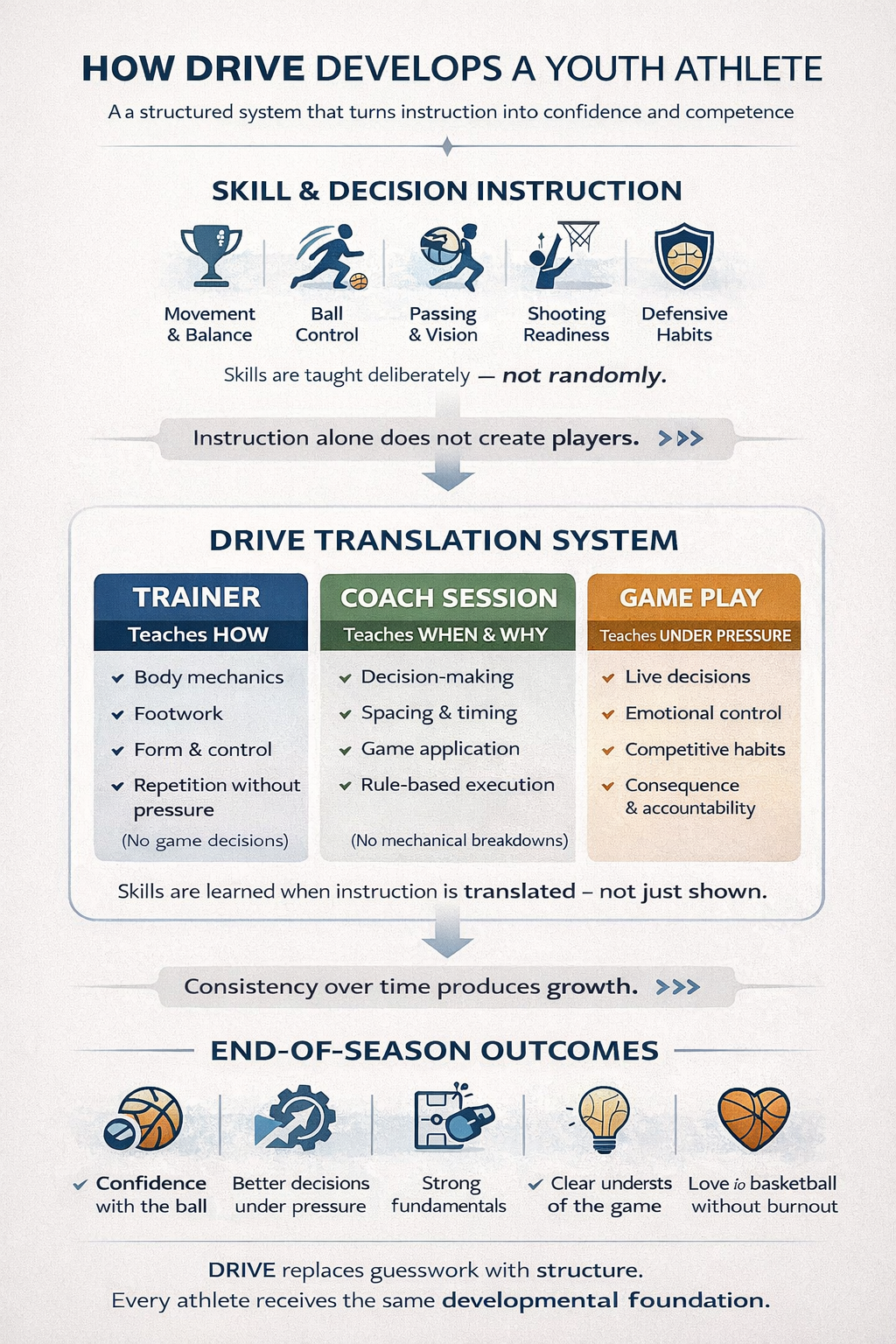
How DRIVE Works (Simple)
Why DRIVE Exists
Most youth leagues run on volunteer knowledge and weekly “topics.” That can organize a season, but it does not reliably develop athletes. DRIVE exists to replace guesswork with structure — so development survives staff turnover and every athlete gets a real foundation.
Same language and standards across teams, tiers, and weeks.
Players work at the right level of speed, pressure, and complexity.
Trainers teach HOW. Coaches teach WHEN & WHY. Games teach under pressure.
Parents can recognize progress in decisions, habits, and composure.
What We Expect From Parents
- Support learning — do not coach from the sideline
- Help athletes arrive prepared (rest, hydration, focus)
- Measure progress using the success markers above
- Trust the process: development is not linear
End-of-Season Outcome (The Goal)
A DRIVE athlete finishes the season with more than “experience.” They finish with a stronger foundation that transfers to school basketball, higher competition, and future seasons.
- Confidence and competence in core fundamentals
- Better decision-making under speed and fatigue
- Improved defensive habits and team awareness
- More composure, leadership, and accountability